Showing posts with label Research. Show all posts
Showing posts with label Research. Show all posts
Tuesday, 16 December 2014

Monday, 17 November 2014
Music and Sound
After shooting our opening for the first time, I began experimenting with various pieces of music that would compliment our footage well and fit into the horror genre. I wanted to find music that featured eerie and uncomfortable sounds that would put my audience on edge when watching. When watching, I want them to feel uncomfortable and scared and music will help in doing this.
For inspiration, I have researched a variety of slasher horror soundtracks. This helped me know what music I was looking for. I learnt what was needed in a horror movie soundtrack for it to be frightening, for example, staccato. All soundtracks are discordant and jarring which is what will put the audience on edge and make them feel uncomfortably scared when watching which is what I aim to do as I feel music plays a big part in scaring an audience. Below are the three major slasher soundtracks I researched, Friday the 13th, A Nightmare on Elm Street and Halloween.
Friday the 13th
A Nightmare on Elm Street
Halloween
From these soundtracks from popular slasher horror films Friday the 13th, A Nightmare on Elm Street and Halloween it made it easier to know what soundtrack I wanted for my opening. I searched for copyright free music on www.purple-planet.com and found some that I thought would match my footage well. Below are 3 soundtracks that I considered to have in my opening.
Insidious: This soundtrack begins to set an eerie atmosphere but as it goes on, uncomfortable sounds are introduced making the piece more harsh and discordant. This matches my footage perfectly as I want to create an eerie, creepy atmosphere at the beginning of my opening when Sam finds the newspaper article about the masked killer, then I want the music to turn more jarring with the use of staccato when Ben enters the forest and the Masked Killer is shown for the first time. I ended up choosing this soundtrack to be the one featured in my opening as I feel as if it would match the footage just as I want it to.
Sepulchral: I liked this soundtrack due to the distorted piano as I feel as if it could make the audience feel uncomfortable with fear and suspicion. The piano could also link to the vulnerable and child-like nature of Sam as he is scared when he finds the newspaper article about the masked killer. However, I do not feel as if this piece would compliment my footage just as much as I would like it to. Also, I believe this distorted piano soundtrack would sound better in a paranormal horror film, not a slasher as slasher films tend to be a lot more jarring and fast-paced, like the three existing examples above.
Executor: Similarly to the first of my chosen soundtracks, this one features jarring and discordant sounds to make the audience feel uncomfortable with fear. However, I prefer the first one in the way that it builds up instead of starting jarring straight away. I do not feel as if this would match my opening at the beginning when Sam and Ben are speaking.
After receiving feedback from my draft opening, I realised I needed to feature more sound effects. As a result I have since added some sound effects to make my footage look more effective and to conform to the slasher horror genre. Before, GB turned around when he was in the forest however there were no noises as to why he did turn around, so I added a sound effect of a twig snapping. Furthermore, I added a sound effect of the Masked Killer breathing through the gas mask over the POV shots to make it clear that it is a point of view from a killer and at the end when he kills GB, I believe this has made the ending of the opening more scary for audiences.
Sunday, 16 November 2014


Tuesday, 4 November 2014
Codes and Conventions of Horror Sub-Genres
In the horror genre, come many sub-genres. These include:


- Slasher Horror
- Psychological Horror
- Gothic Horror
- Science Fiction Horror
- Zombie Horror
- Paranormal Horror
- Creature Feature Horror
- Found Footage Horror
Although all horror films have the horror theme in common, all sub-genres feature different codes and conventions, these include narratives, titles, character types, settings, font styles and colours. I will be researching three popular sub-genres; Slasher Horror, Paranormal Horror and Found Footage Horror.
Slasher Horror
Usually in a Slasher Horror, teenagers or young adults go on a vacation and move into a house or camp out in an abandoned area for a while (Friday the 13th: 2009). Before the main story line however, a prelude is usually seen before that gives the audience knowledge of what may occur in the main film (Halloween: 1978). As well as older teenagers, a masked killer who may never be revealed throughout the film is also a main character as they are the ones who make the film a slasher due to their selection of weapons that they kill people with, for example a knife (Scream: 1996) or a chainsaw (The Texas Chainsaw Massacre: 2003). Font styles are commonly bold and shown in a serif font suggesting the seriousness of the sub-genre. Red texts are also commonly used to suggest blood, death, rage and danger; all linking to the Slasher sub-genre. White text may also be used on a black background suggesting good vs. evil (the innocence from the victims vs. the rage of the masked killer).
Paranormal Horror
This sub-genre of horror usually centres around the 'perfect' family of a mother, father and children but slowly we realise not everything is so perfect in this family as strange things start occurring around them. Although Paranormal Horror's aren't always set back in time, they normally involve the devil as this links with the dead and paranormal occurrences. In The Conjuring: 2013, the family witness various strange paranormal activity in their new house and then the mother becomes possessed by the devil. The devil is also involved in Annabelle: 2014, a prequel to The Conjuring when the doll comes back to haunt them no matter how many times the family throws it away. Paranormal investigators are also casted in Paranormal Horrors often to attempt to solve the mystery of the devil figure that is haunting them. These types of horror films usually are set in the houses of the family who are being targeted by the devil (The Exorcist) Black text is commonly used for this type of sub-genre of horror as it suggests power, death, evil, mystery and fear of the unknown. Red text may also be used often to suggest blood, rage and danger and also the devil that is commonly involved in Paranormal Horror.
Found Footage Horror
In Found Footage Horror, character types vary throughout film to film and as does the narrative. Usually in this type of horror sub-genre, a group of people visit an abandoned area to either solve urban legends or something that they want to know more about. In The Blair Witch Project: 1999, teenagers set out to make a documentary about the Blair Witch, similar to Willow Creek: 2013, where two young adults set out into a quiet forest in California to attempt to get their own Bigfoot footage as one of them is a Bigfoot believer. In Paranormal Activity however, a family is witnessing strange occurrences in their house so they set up cameras around the house to try to solve what is happening in the night. Formal, typewriter-like font that is similar to fonts in news articles are used to suggest the footage that is shown is real life, not just a made up story. This can be backed up by the opening credits of many Found Footage Horror films; usually a white typewriter-like font appears on a black background telling the viewers what they are about to see is based on true events. For example, in The Blair Witch Project, viewers are told the three teenagers who set out to make a documentary where never seen or heard from again and their footage was discovered a year later. The white text on black background suggests good vs. evil from the innocent victims and the evil characters, whether the be a witch, Bigfoot or a poltergeist.
In Found Footage Horror, character types vary throughout film to film and as does the narrative. Usually in this type of horror sub-genre, a group of people visit an abandoned area to either solve urban legends or something that they want to know more about. In The Blair Witch Project: 1999, teenagers set out to make a documentary about the Blair Witch, similar to Willow Creek: 2013, where two young adults set out into a quiet forest in California to attempt to get their own Bigfoot footage as one of them is a Bigfoot believer. In Paranormal Activity however, a family is witnessing strange occurrences in their house so they set up cameras around the house to try to solve what is happening in the night. Formal, typewriter-like font that is similar to fonts in news articles are used to suggest the footage that is shown is real life, not just a made up story. This can be backed up by the opening credits of many Found Footage Horror films; usually a white typewriter-like font appears on a black background telling the viewers what they are about to see is based on true events. For example, in The Blair Witch Project, viewers are told the three teenagers who set out to make a documentary where never seen or heard from again and their footage was discovered a year later. The white text on black background suggests good vs. evil from the innocent victims and the evil characters, whether the be a witch, Bigfoot or a poltergeist.
Monday, 20 October 2014


Thursday, 16 October 2014
Close Analysis of Horror Openings
I am going to be watching 5 different
horror film openings and analysing the action that takes place, print styles
and sound in all of them. The films openings I have chosen are:
o Psycho
o Dark Skies
o Evil Dead
o The Shining
o House at the End of the Street
Action
Horror films tend to be opened in various ways. We are usually opened with a prelude where we see the same character or location that we are going to see in the main film. This is to create dramatic irony for the viewer where the viewer may know more than the character in the film. However many films before preludes became popular, opened with credits, like Psycho (1960).
In the opening to Psycho we are introduced to the main title credits. This is shown in a different and more interesting way than other films before Psycho were. Furthermore, the audience are able to establish the genre from the opening. We see fragmented bars that are splitting text in half that suggests Psychos fragmented mind and split personality. The way the lines and text enter the screen suggests a knife, linking to the theme and once again the genre. The names are also not revealed straight away reflected the concealed nature of the killer; Psycho hides his true identity as someone else. The opening of Psycho is very different to openings of films that are made today, for example, Dark Skies.

In the opening to Dark Skies we are introduced to a street located in Suburban America; suggesting this is where the action will mostly take place in the film. On this street we see how people imagine Suburban America to be; lively and sunny. This subverts the audiences expectations of a horror film as we expect the film to begin in a dark, isolated area which is the complete opposite of what we see. Then a straight cut is used and we see fire from the burgers the father is cooking on the barbecue. The fire is significant in the scene where we are introduced to the family as it suggests something bad is going to happen to the family as fire is usually linked to death. They all look happy and content with their lives, but knowing this is a horror film, all this is about to change.

The opening to Evil Dead can be compared to Psycho as we are introduced to the main actors and producers with things going on in the background as apose to Dark Skies where we are introduced to the main film in the opening. In the opening to Evil Dead we see iconography used very effectively. According to Bordwell and Thompson’s theory iconography can be defined as “recurring symbolic images that carry meaning from film to film”. Red and black are the only colours used throughout the opening, with the orange from the fire used towards the end. Red connotes blood and can be associated with danger and war. Whilst black can be associate with power, evil and mystery. We see blood, spikes, knives and chains in the opening suggesting this film is going to be a slasher horror. The blood splashes throughout the opening suggests there will be some gruesome scenes ahead, for example, the tearing of limbs. Towards the end we see orange flames that suggest a theme of the devil and again establishes the genre of the film of horror. There is also a quick flash of a wall with the words "your soul" handwritten on again, suggesting to the devil. Iconography of a horror film has also been used in an earlier film, the Shining.

In the opening of The Shining the camera first zooms into an isolated island in the middle of a lake suggesting this film will be based around isolation (iconography). We are then introduced to a car driving up a mountain, getting closer to an unknown destination. We see the car drive through woodland areas suggesting the mystery of where he may be going and fear of the unknown. The audience does not know where the car is going and who is driving the car. Throughout the whole opening we only see a few other cars, the car the camera is following is almost alone and isolated. Although we do not see who is driving the car, we realise who ever it is, is the main character as the camera is only following them. We also realise the car has been travelling for a while as the snow on the mountain represents how high he has travelled; the higher the driver gets, the more isolated they are. At the end of the opening we see the hotel the driver has been travelling to, it is isolated and in the middle of no-where which meets the audiences expectations of a horror film.

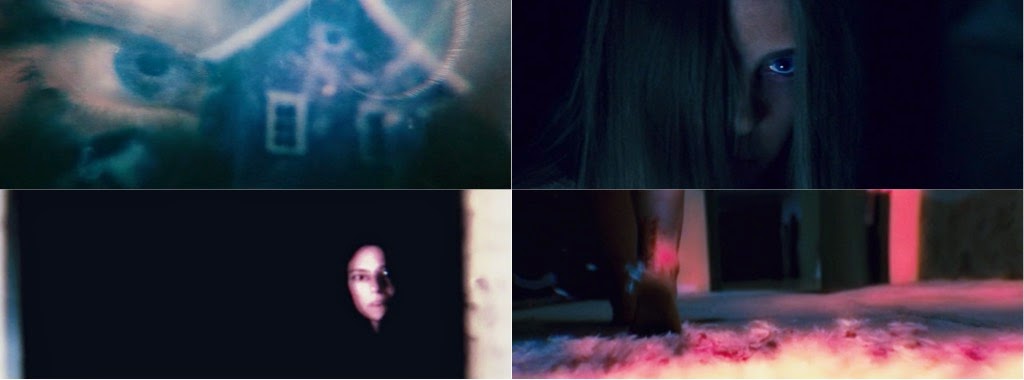
Although we are introduced to the main film straight away in the opening to Dark Skies and The Shining, In the opening to House at the End of the Street we are introduced to a prelude. A method many 21st century horror films directors use. We first see a house and snow falling from the sky then a child’s eye in the background of this. We then realise that the house is in a snow globe that the child is holding. We only see one of her eyes suggesting the devil which tells the audience that she is evil, and we realise she is when she kills both her parents for no apparent reason. As she kills her father on his bed we see feathers from pillows hit the floor. The feathers go from white to red as they are covered in blood. This suggests the loss of innocence and childhood from the girl; the white connotes purity whereas red connotes danger. Throughout the opening there are glitches where it quickly changes to a thermal camera effect. This suggests what the girl sees in her mind as she is far from normal. At the end of the opening we see the girl run off into the woods, leaving many possibilities open for the audience to work out what happens next and to keep them on the edge of their seats.
Print Styles
o Psycho
o Dark Skies
o Evil Dead
o The Shining
o House at the End of the Street
Action
Horror films tend to be opened in various ways. We are usually opened with a prelude where we see the same character or location that we are going to see in the main film. This is to create dramatic irony for the viewer where the viewer may know more than the character in the film. However many films before preludes became popular, opened with credits, like Psycho (1960).
In the opening to Psycho we are introduced to the main title credits. This is shown in a different and more interesting way than other films before Psycho were. Furthermore, the audience are able to establish the genre from the opening. We see fragmented bars that are splitting text in half that suggests Psychos fragmented mind and split personality. The way the lines and text enter the screen suggests a knife, linking to the theme and once again the genre. The names are also not revealed straight away reflected the concealed nature of the killer; Psycho hides his true identity as someone else. The opening of Psycho is very different to openings of films that are made today, for example, Dark Skies.
In the opening to Dark Skies we are introduced to a street located in Suburban America; suggesting this is where the action will mostly take place in the film. On this street we see how people imagine Suburban America to be; lively and sunny. This subverts the audiences expectations of a horror film as we expect the film to begin in a dark, isolated area which is the complete opposite of what we see. Then a straight cut is used and we see fire from the burgers the father is cooking on the barbecue. The fire is significant in the scene where we are introduced to the family as it suggests something bad is going to happen to the family as fire is usually linked to death. They all look happy and content with their lives, but knowing this is a horror film, all this is about to change.
The opening to Evil Dead can be compared to Psycho as we are introduced to the main actors and producers with things going on in the background as apose to Dark Skies where we are introduced to the main film in the opening. In the opening to Evil Dead we see iconography used very effectively. According to Bordwell and Thompson’s theory iconography can be defined as “recurring symbolic images that carry meaning from film to film”. Red and black are the only colours used throughout the opening, with the orange from the fire used towards the end. Red connotes blood and can be associated with danger and war. Whilst black can be associate with power, evil and mystery. We see blood, spikes, knives and chains in the opening suggesting this film is going to be a slasher horror. The blood splashes throughout the opening suggests there will be some gruesome scenes ahead, for example, the tearing of limbs. Towards the end we see orange flames that suggest a theme of the devil and again establishes the genre of the film of horror. There is also a quick flash of a wall with the words "your soul" handwritten on again, suggesting to the devil. Iconography of a horror film has also been used in an earlier film, the Shining.
In the opening of The Shining the camera first zooms into an isolated island in the middle of a lake suggesting this film will be based around isolation (iconography). We are then introduced to a car driving up a mountain, getting closer to an unknown destination. We see the car drive through woodland areas suggesting the mystery of where he may be going and fear of the unknown. The audience does not know where the car is going and who is driving the car. Throughout the whole opening we only see a few other cars, the car the camera is following is almost alone and isolated. Although we do not see who is driving the car, we realise who ever it is, is the main character as the camera is only following them. We also realise the car has been travelling for a while as the snow on the mountain represents how high he has travelled; the higher the driver gets, the more isolated they are. At the end of the opening we see the hotel the driver has been travelling to, it is isolated and in the middle of no-where which meets the audiences expectations of a horror film.
Although we are introduced to the main film straight away in the opening to Dark Skies and The Shining, In the opening to House at the End of the Street we are introduced to a prelude. A method many 21st century horror films directors use. We first see a house and snow falling from the sky then a child’s eye in the background of this. We then realise that the house is in a snow globe that the child is holding. We only see one of her eyes suggesting the devil which tells the audience that she is evil, and we realise she is when she kills both her parents for no apparent reason. As she kills her father on his bed we see feathers from pillows hit the floor. The feathers go from white to red as they are covered in blood. This suggests the loss of innocence and childhood from the girl; the white connotes purity whereas red connotes danger. Throughout the opening there are glitches where it quickly changes to a thermal camera effect. This suggests what the girl sees in her mind as she is far from normal. At the end of the opening we see the girl run off into the woods, leaving many possibilities open for the audience to work out what happens next and to keep them on the edge of their seats.
Print Styles
Horror films tend to use serif fonts for their print in opening scenes. For the print, red, black and white are commonly used as this is stereotypical for the genre of horror. Red represents blood and danger, two things horror films commonly use to scare their audiences. Black is used to represent fear of the unknown of villains whereas white is the opposite, representing innocence and purity of the good characters. White text on black backgrounds are commonly used to suggest good vs. evil.
In the opening to
Psycho there is a black background throughout featuring white text. The white
on black suggests good vs. evil as white usually relates to the good as it
represents purity and innocence whereas black usually relates to the evil as it
represents fear of the unknown and mystery. Serif font is used to reflect the
serious tone of the film and to establish the genre of horror. It is also clean
and easy to read unlike fonts used in chick flicks, for example.

In the opening to Dark Skies white text (of a quote) fades in onto a black background, again suggesting the good vs. the evil. The black represents the fear of the unknown, linking greatly with this film. It begins in a similar way to how the whole Psycho opening is (white on black background). There is also red text used to give the suggestion that this a horror film as red connotes blood and danger; things we often associate with horror. The title of the film fades in from the darkness of the black background, almost like a space ship entering earth from space; linking in with the science fiction horror genre this film is. The opening credits all fade in throughout the opening in a white font, which may connote purity and innocence reflecting the neighbourhood. The fading in of the serif, white font may reflect the serious message and tone the film is expressing; children getting taken away by unknown figures.

In the opening to Evil Dead the main title appears and zooms in on the audience. The font is red and is in a bold style. The director, Fede Alvarez called the opening titles “a homage to gore”. We also see silhouettes of tree branches coming from the black background and over the font. This links to the horror genre with not only the colours used but from the tree branches too. When the leaves fall off trees, they look empty and almost creepy, we can associate this with Halloween and dark nights. The red on black text also could be compared to the Dark Skies opening as they use red on a plain black background.

In the opening to The Shining we see blue text appear from the bottom of the screen and travel to the top in a typical way credits are usually shown. This reflects what the car is doing at this exact moment; much like the text, the car is travelling from the bottom to the top, in this case on a mountain. Blue usually connotes cold and isolation linking the hotel the driver is travelling to. The font is shown in a serif font reflecting the seriousness and formality of the film. Although blue is used to suggest isolation, it is rarely used in horror films as red, black and white are the main colours that they use in openings as they connote blood, death, fear of the unknown, power and innocence.

In the opening to House at the End of the Street the main text is shown in a formal font that appears to be written by a typewriter linking with the horror genre. The font changes from this typewriter-like font to a young handwritten childlike font linking with the child that the film centres around. The font is creepy and fits well within the genre of the film; it almost looks confused reflecting the child’s mind. Much like in Psycho, House at the End of the Street use white text on a black background to suggest good vs. evil.

Sound
In the opening to Dark Skies white text (of a quote) fades in onto a black background, again suggesting the good vs. the evil. The black represents the fear of the unknown, linking greatly with this film. It begins in a similar way to how the whole Psycho opening is (white on black background). There is also red text used to give the suggestion that this a horror film as red connotes blood and danger; things we often associate with horror. The title of the film fades in from the darkness of the black background, almost like a space ship entering earth from space; linking in with the science fiction horror genre this film is. The opening credits all fade in throughout the opening in a white font, which may connote purity and innocence reflecting the neighbourhood. The fading in of the serif, white font may reflect the serious message and tone the film is expressing; children getting taken away by unknown figures.
In the opening to Evil Dead the main title appears and zooms in on the audience. The font is red and is in a bold style. The director, Fede Alvarez called the opening titles “a homage to gore”. We also see silhouettes of tree branches coming from the black background and over the font. This links to the horror genre with not only the colours used but from the tree branches too. When the leaves fall off trees, they look empty and almost creepy, we can associate this with Halloween and dark nights. The red on black text also could be compared to the Dark Skies opening as they use red on a plain black background.
In the opening to The Shining we see blue text appear from the bottom of the screen and travel to the top in a typical way credits are usually shown. This reflects what the car is doing at this exact moment; much like the text, the car is travelling from the bottom to the top, in this case on a mountain. Blue usually connotes cold and isolation linking the hotel the driver is travelling to. The font is shown in a serif font reflecting the seriousness and formality of the film. Although blue is used to suggest isolation, it is rarely used in horror films as red, black and white are the main colours that they use in openings as they connote blood, death, fear of the unknown, power and innocence.
In the opening to House at the End of the Street the main text is shown in a formal font that appears to be written by a typewriter linking with the horror genre. The font changes from this typewriter-like font to a young handwritten childlike font linking with the child that the film centres around. The font is creepy and fits well within the genre of the film; it almost looks confused reflecting the child’s mind. Much like in Psycho, House at the End of the Street use white text on a black background to suggest good vs. evil.
Sound
Sound is a key convention in helping the audience identify the genre of a film is a horror. Low pitch music is commonly used to reflect the dark element of horror films, suggesting there will be scenes where you will see blood, gore and demonic creatures.
In the opening to Psycho, dramatic music begins straight away. This establishes the tone of the film and suggests there may be jump scares. Staccato is used to emphasise a ‘jabbing’ sound reflecting the stabbing motion with a knife that is going to appear in the film, especially in the famous shower scene. The opening begins with a low pitch tone, which is dark, scary and even sinister then converts to a high pitch tone which sounds almost like screams again reflecting what will happen in the film. The music is quick paced that gradually grows just like the bars which puts the viewers on edge and creates a sense of panic.
In the opening to Dark Skies we hear a futuristic screeching noise that you could relate to aliens and space suggesting what we will see in the film. When the main title appears, the sound gets louder and almost turns into a high pitch whistle, which may make audiences uncomfortable. Although what we are seeing throughout the opening are children playing, laughing and having a good time, the music does not quite fit the mise en scene. Violins play throughout the scenes of the neighbourhood, which gives the audience a sense that not everything is as it seems; something is going to happen. The violins create a dark and eerie vibe whilst we see the people out in the neighbourhood.
In the opening to Evil Dead dramatic music begins straight away, much like in Psycho. This also suggests there may be jump scares in the film and establishes the overall tone. The harsh tones of the violins are used to reflect the genre of the film also. The music that plays is sang by what we assume is a choir. This reflects the sub-genre of supernatural horror as we relate a choir with churches, god and the devil. The high-pitched choir like voices turn into to a deep and aggressive tone when we see the fire; almost acts like the voice of the devil. The haunting voices from the choir put the audience on edge.
Whereas Psycho and Evil Dead use fast paced staccato music in their openings, In the opening of The Shining we hear slow, deep, low-pitched music that is similar to music that may be played at a funeral. This is a key convention of helping the audience establish the genre of horror. It makes the audience feel uncomfortable as it is mysterious which fits with the mise en scene; we do not yet have an idea of the car’s destination. When the car is getting higher up the mountain a scream-like noise is introduced giving an idea of what we may happen in the film.
In the opening to The House at the End of the Street there is dramatic instrumental music that gets louder and suddenly stops when there is a cut from black to close up of a snow globe, what the girl is holding. Music is not used throughout the whole opening like in Psycho and The Shining, we hear various sounds. The sounds we hear all fit in time with the action we see. The hallway is silent where we see the girl except from her footsteps and the sound of thunder coming from outside, which is an example of pathetic fallacy as the weather is reflecting the mood. The opening is very quiet, apart from the thunder outside, until we hear screams coming from both parents as the daughter kills them. Screams, thunder and footsteps from creaky floorboards are all typical in horror films as it helps establish the genre and makes the audience uncomfortable. When we see the girl alone in the hallway, whilst we see close ups of her eye, we hear mumbled voices and various creepy noises; we get the sense these noises are all in her head as she is clearly troubled.

In the opening to Psycho, dramatic music begins straight away. This establishes the tone of the film and suggests there may be jump scares. Staccato is used to emphasise a ‘jabbing’ sound reflecting the stabbing motion with a knife that is going to appear in the film, especially in the famous shower scene. The opening begins with a low pitch tone, which is dark, scary and even sinister then converts to a high pitch tone which sounds almost like screams again reflecting what will happen in the film. The music is quick paced that gradually grows just like the bars which puts the viewers on edge and creates a sense of panic.
In the opening to Dark Skies we hear a futuristic screeching noise that you could relate to aliens and space suggesting what we will see in the film. When the main title appears, the sound gets louder and almost turns into a high pitch whistle, which may make audiences uncomfortable. Although what we are seeing throughout the opening are children playing, laughing and having a good time, the music does not quite fit the mise en scene. Violins play throughout the scenes of the neighbourhood, which gives the audience a sense that not everything is as it seems; something is going to happen. The violins create a dark and eerie vibe whilst we see the people out in the neighbourhood.
In the opening to Evil Dead dramatic music begins straight away, much like in Psycho. This also suggests there may be jump scares in the film and establishes the overall tone. The harsh tones of the violins are used to reflect the genre of the film also. The music that plays is sang by what we assume is a choir. This reflects the sub-genre of supernatural horror as we relate a choir with churches, god and the devil. The high-pitched choir like voices turn into to a deep and aggressive tone when we see the fire; almost acts like the voice of the devil. The haunting voices from the choir put the audience on edge.
Whereas Psycho and Evil Dead use fast paced staccato music in their openings, In the opening of The Shining we hear slow, deep, low-pitched music that is similar to music that may be played at a funeral. This is a key convention of helping the audience establish the genre of horror. It makes the audience feel uncomfortable as it is mysterious which fits with the mise en scene; we do not yet have an idea of the car’s destination. When the car is getting higher up the mountain a scream-like noise is introduced giving an idea of what we may happen in the film.
In the opening to The House at the End of the Street there is dramatic instrumental music that gets louder and suddenly stops when there is a cut from black to close up of a snow globe, what the girl is holding. Music is not used throughout the whole opening like in Psycho and The Shining, we hear various sounds. The sounds we hear all fit in time with the action we see. The hallway is silent where we see the girl except from her footsteps and the sound of thunder coming from outside, which is an example of pathetic fallacy as the weather is reflecting the mood. The opening is very quiet, apart from the thunder outside, until we hear screams coming from both parents as the daughter kills them. Screams, thunder and footsteps from creaky floorboards are all typical in horror films as it helps establish the genre and makes the audience uncomfortable. When we see the girl alone in the hallway, whilst we see close ups of her eye, we hear mumbled voices and various creepy noises; we get the sense these noises are all in her head as she is clearly troubled.
Subscribe to:
Posts (Atom)